‘The Assassin of Diguvametta’

 ‘The Assassin of Diguvametta’ is a story by Kenneth anderson in his book Tales from the Indian Jungles. He expresses his intense love of India here, why he preferred to stay in India than in any other western country. He says that dense forests, the utter solitude of a jungle within fifty miles from his home, the varied languages and dialects of the towns, tribesmen are all these reasons that made him to stay in India. He further states that, “My friends cannot understand when I tell them that these things are the reasons why I love India, why I do not think I shall ever leave it.’’ (Anderson Tales from the Indian Jungles 92.)


New look of RS :"There was no passenger train in the direction of Basavapuram during the day, but fortunately a goods train was scheduled to pass through at about eleven that very morning. The station-master stopped the train for me, and I travelled in the guard's van to Basavapuram".


Broad gauge train at Diguvametta RS in a rainy day: "I had now spent some five days in this area,The jungles had been exceptionally silent since my arrival. Another reason for choosing Diguvametta as my camping-  place, at least for the present, was of course the fact that it was here that the tiger had last killed, just over three days previously.  the jungle was in- tensely dry,  We had combed the area in a radius of well over two hundred yards and found nothing, not even a remnant of torn cloth from her garment.  I did not want to disturb the area further, for it had already been disturbed by the party of men who had come searching for the girl and found her basket"


The meter gauge train and vegetation of the around the area. The  pictures captured as screen shot and   are from a 1990 Telugu romantic comedy film named Bobbili Raja (Telugu: బొబ్బిలి రాజా) directed by B. Gopal. It stars Venkatessh in the lead role and Divya Bharati in her film debut alongside Vanisree, and Kaikala Satyanarayana in other roles. Music was scored by Ilayaraja. This means  atleast untill 1990 there was regular traffic though this route.


The OLd track in KA stories track passed through the Nallamala Hills and as a result quite a few major engineering works were undertaken in the course of the railroad construction, the most impressive of them being the massive Dorabavi Viaduct and the Bogada Tunnel (We cam name it Old Bogada LONG tunnel , as per KA) both of them about 30 km from Nandyal. This section was converted to Broad Gauge during 1993-95. The gauge conversion was a difficult task owing to the difficult terrain. The old alignment between Gazulapalli and Diguvametta was abandoned and a new Bogada tunnel, about 1.6 km in length and a new Dorabavi Viaduct located at a much lower altitude were constructed at a huge expense.


The exclusive bridge Dorabavi viaduct was engineering monument in the South Central Railway,

The serene forest location of the bridge, on the Nallamala Hills, had its own exotic aura as a picnic spot.This viaduct had great historic back ground as British engineers did awesome work and opened the metre gauge traffic in the year 1887, Deep gorges of Nallamala forest and hillock regions were connected through the above bridge.Nearly 420 tons of steel was procured from the Burming Ham Steel Industry, in Briton. The Railway authorities had also dug a well named Dorala Bavi to mitigate drinking water for the British rulers during their halts.


KA described in another story as he looked down from the bridge , where treetops far below. However, the 110-year old bridge continued to be a great picnic spot for the tourists though it was discontinued due to the construction of an alternative route as part of gauge conversion between Nandyal and Giddalur.


Mercilessly, the Railways had sold out the monument as scrap for just Rs 4 crore and the Doravri Bridge was destroyed for Iron scarp. Presently, a shape less structure stands at the spot.

 The location  of the story is the  present forests between Chelama and Diguvametta in the state of Andhra Pradesh. Anderson admires picturesque scenery of that area and it provided him utter peace and solitude and the friendship with wild Chenchu tribesmen.  Anderson tells  his visit to Diguvametta and his stay at the forest bungalow whose caretaker was his old friend Aleem Khan. It was Aleem Khan who informed him about a panther that proved troublesome in future. The panther dragged away his dog from the forest bungalow. Then he continues his account of his stay at Diguvametta forest bungalow where he meets the district forest officer, (D.F.O.) His meeting with D.F.O. is very interesting, he passes political comment and expresses his dislike of the government officers.. Anderson also narrates how he purchased a small plot of land from Ranga Reddy at Diguvametta to  get rid over the government officers in occupying forest bungalows.  The D.F.O. invited him to shoot the panther but Anderson failed to shoot it. Then he returned to Bangalore. After four months Anderson received a letter from Aleem, reporting that the panther had killed a railway ganger between the long bridge and the water-column. Then next letter came about a month later reporting another human kill by the panther. Then he received the telegram from Aleem informing him that Panther had killed his sister’s child. Anderson rushed to Diguvametta and came to know about that incident. He learns that the panther dragged the girl from a little grave under a stone slab ‘mischief.’ Anderson narrates the story of the British forest officer and his little dog named ‘mischief’. Anderson decided to sit on the tombstone at night to wait for the panther but it did not turn on that night. Then he.  received information that the Chenchu tribesman was killed by the panther on the same night. So he made another plan with Aleem. Both of them would hide somewhere on the hillside above the mouth of the railway tunnel. The final encounter with the panther was horrible experience for Anderson and he has described it vividly. The panther attacked on them from behind and there was face to face fight between them. Anderson fired into the face of the panther at point-blank range, and it fell with a loud thud upon the railway track below

https://blogger.googleusercontent.com/img/b/R29vZ2xl/AVvXsEhy0qOooJIjEKZSfDPF84OOuQQv9liNKgLJQLo7fZSTd-kCm11GMgE-ziGOLoo-OfPCFxucHEIyZ0mQoEKPUPJP6Sf96qfkf_j4CzOdlIZ3W5iCLqNzq1d0MdNABkiSg55BH7mE6nBcaA/s640/12.jpg
JOSHUA MATHEW visited the place, and rediscovered in this video. please click here  to see it on you tube

The one–legged Dutchman of wild Heritage- guide for walkback.

“The one-legged Dutchman of Wild Heritage”.
It is a story based on Masinagudi villages and Sigur river, By Kenneth Anderson. This story is an excellent specimen for a virtual walk back. The plot is well connected to the story and presents deep insights of Anderson's favorite spots among his lands.
 In this Passage, Anderson portrays Captain Jonklaas, a respectable gentleman, a tea-planter from Ceylon. He was the Dutch who had come to South India to satisfy a long-felt need to see, hear or shoot the king of Asiatic jungles- the tiger, and his experience on the fighting of different species of animals.

Picture in our mind.!


The first page of the story


 Captian Jonklaas had a wonderful idea of constructing a hut right in the heart of the wilds to entertain his visitors from the west in royal style. The bungalow was built of giant bamboos throughout and the place named ‘Wild Heritage’. Now the property is situated at Mavanahalla, and has a campsite named 'Quiet corner'. Even today the name was very appropriate because it provided wide open spaces, animals, birds, flowers and trees, the scent of the jungle by daytime and the secret calls of wild animals in the night.  The place ‘Wild Heritage’ was paradise in true sense for all Nature Lovers. 
Quiet Corner Campsite is an excellent place for Retreats, Youth Camps and Conferences with a capacity of 250 people,( Red Circle), under a Gospel Missionary. Cheetal Walk(Davidars place) is marked in yellow and Serenity(Andersons's Hut*) is marked in blue. We must be obliged to non-developing that stretch of land and adjacent areas to ERC Davidar and Segure Nature Trust. and The place is well in touch with Nature Lovers.

The entrance gate of  Quiet corner.

Mavanahalla can be  reached by road easily from Bangalore


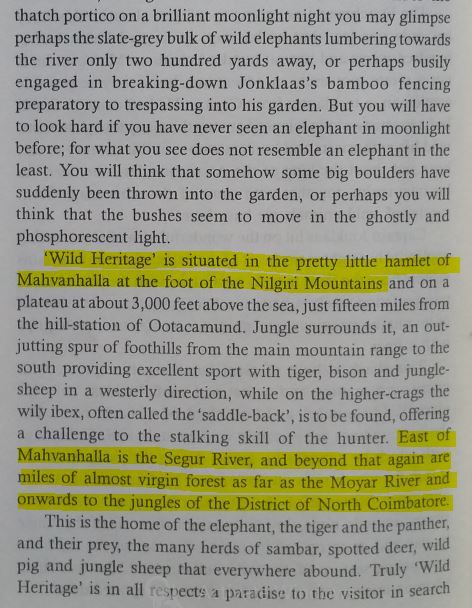
Anderson presents the topography of the ‘Wild Heritage’. It was situated in the pretty little hamlet of Mahvanhalla at the foot of the Nilgiri Mountains. 

Anderson describes virgin forest from east of Mahvanhalla on the bank of the Segur river as far as the Moyar river. This dense forest was the home of the elephant, the tiger, and the panther, and their prey, the many herds of sambar, spotted deer, wild pig, jungle sheep that everywhere abound.

View of Nilgiri hills from Quiet corner. Captain Jonklaas had fallen in love with that place and had formed the habit of returning each year in winter to shoot his annual tiger.

KA said that the Captain told him that the jungles of Ceylon are beautiful but is there are no tigers. Thus it was the attraction of the tiger that brought Capt. Jonklaas to south Indian jungles.

The Quiet Corner campsite is now an economical getaway for groups and families providing stay and food. Here one can choose wildlife safaris and capture the true spirit of the forest and wildlife.

Over the years, thousands of people have visited the Campsite and made good use of the facilities. They charge affordable stay with food.


Mavanahalla  Bustop


As you are already aware Kenneth Anderson used different spellings for certain terms. Synonyms used in the story:

Anaikutti= Anaikatti, Anaikutty Forest bungalow
Segur River = Sigur River
Banana Plantation =Vazhaithottam
Masinigudi=Masinagudi,Masanam gudi(T).
Mahvanhalla=Mavanahalla,Mavanalla
Tippakadu=Theppakkadu
Moyar river= Mayar in Tamil
Hundi= (probably)Guruvegawnder Hundi
Benur=(probably) Belthur


East of wild heritage is Sigure river and Moyar forest beyond

There is an old building inside quite corner. We don't know whether it is related to the original bamboo shack of Jonklaas.


Anderson admires CAptain's love of jungles and wild animals. He mentions that despite his great physical handicap Jonklaas managed to wander in the jungle with the aid of an artificial leg.


 Anderson then narrates Captain Jonklaas’ two interesting adventures. The first adventure is that of the killing of a lone male tiger of Mahvanhalla who for many years haunted the banks of the Segur river. The second adventure is his encounter with the one-tusked rogue elephant that operated at kilkotagiri in the Nilgiri Mountains. Anderson’s unique style of narration of such exciting and thrilling adventures makes this passage very interesting to read.


Photo was taken by KA . Mr. Henderson ,planter who was killed by the one-tusked rogue elephant that operated at Kilkotagiri. Photo Courtesy: Joshua Mathew. 
In search of misogynist, -the lone male tiger- of Mahvanhalla who many years haunted the banks of the Segur river.

Mavanahalla stream(RED) joins to Sigur river(BLUE)  near the bungalow- wild heritage

The Beat begins. If you read carefully about the passage you will get a mental picture like one in the below.
The tiger was active in Mudumalai area and starting its beat from Theppakadu. then to Hundi. (Guruvegowdan Hundi.)The dam described here maybe either Moyar dam or Mangala dam. I prefer Mangala dam because of its closeness of Hundi. Belthur and Anaikatty FB are marked. The tiger had a camp for two weeks near Mavanahalla and then return to Theppakadu.

Banana plantation described here must be the Village called Vazhaithottam. This area is described as Valaithothu in Anderson's other story 'TheSwamy of Valaithottu"
Benur is not found on the proposed beat route. Probably the village Belthur at the edge of forest misspelled as Benur. Just for a calculation by google earth, the total distance is about 80 miles.

Karnataka -TN border observed a fight between two Tigers. It was at a distance of 3 miles from Theppakadu and a kurumba and his wife witnessed the fight.

Anaikatty River and FB. Probable site of water collection by the watchman. He Watched the fight between two tigers in silence and terror and fled away when finished.


A file photo of the river near to Anaikatty FB

Watchman shut the door of his outhouse till next day when vultures flocked above the dead tigress.

Ariel 3 D view of adjacent hills and river around Anaikatty Forest bungalow. The watchman's outhouse is marked in the red circle.

Wild fights witnessed by Jonklaas.
On attempts to bag the tiger. while sitting over machans, Jonklaas witnessed some horrible fights between animals. first one was a rogue an elephant and a tiger.

Positions of heifers (1,2,3,4) around Wild heritage in the shape of a plus mark. 1st one tied near the bank of Mavinahalla stream at North. 2 nd at east on a sandy nullah. 3rd one at a dense bamboo jungle bordering with segure river. The 4th one was tied at a distance of 2 miles to the west of Mavanalla on the lower slope of the spur of the hills.

The 3rd heifer was tied at a place where Segur river at one side and bamboo jungle in the other three sides, on East of wild heritage.  
I wonder and excited to say that the position of the 3rd heifer was somewhere near to a well-known place among nature lovers,  called Cheetal walk. On the way from the main road, we can see Serenity, the property owned by Anderson. The matching descriptions:- Segur river at one side and bamboo jungle in the other three sides, associating with a  margin of clearing on East of wild heritage.  In another passage, KA states that the way to machan is motorable to some extent. 

The great fight between an elephant and a Tiger taken place here (3), and witnessed by Jonklaas.

KA states that the way to machan is motorable to a furlong to Machan(BLACK) . Jonklaas concealed his Standard car under big babool trees (RED) and walked to his Machan, in a direction to the river. I arrived at the assumption that even this time, there is no other motorable roads near to the spot.
The fight
The elephant in action. A tiger killed by an elephant.

Jonklaas escaped from the rogue elephant and decided not to shoot. I was a mistake when thinking retrospectively.

The 2nd incident of a fight between a Tiger and Bison.


Ride on a pony (Yellow Line) towards machan( Blue) beyond a wide stretch of the valley (Red) and the edges of its clearing, at the foot of  spur of the hill. (Black)

Spur of hill and the clearing.
KA With his FRIENDS at his   Mavanhalla hut. Photo Courtesy Joshua Mathew.


Even now  the area is flourished with wildlife

Anderson described the fight in detail

File photo  of a tiger being chased by a Bison

Screenshot from a famous homemade video by a family on a wildlife safari near Masinagudi. Actions of prowling, attack by a Tiger and killing a bison is detailed on that video. 

Link for Video 

The killing of misogynist  by Rodney
Rodney was Jonklaas's son and he believed that he killed the Man-eating tiger incidentally.

Probable site of the action, on the bed of Mavanahalla. Descriptions are matching correctly for such spot of Machan (RED) with two ravines joined to form a bigger nulla, having shola forest along two banks of two nullas. 

Tiger beat started and he came down towards Rodney's Machan. 

A reverse 3Dview of the hills and relative positions of Machan and wild heritage.

You must read the book for an interesting end. Thanking KA for prepare a geographic vs graphic representation of that area in our minds. 

Disclaimer: The post does not claim any authentic study.

*Update:  Got a new info by Naveen AKA   Toon Tiger   in FB:    Excellent write up! This has to be my favorite place. A small input is that the old Jonklass hut was somewhere right of the quiet corner gate as you enter in. I think the second cottage. Also, Kenneth Anderson's plot of land in the area is not where serenity is now, but about 50 meters behind The Davidar's outhouse, this was shown by Mark as well as John of wild haven, and later confirmed by Don when we visited the area in 2010.


Thank you, Naveen. it may be  appropriate that  Anderson's  place  can be re-traced  in  another story titled "What thunderstorm bought"